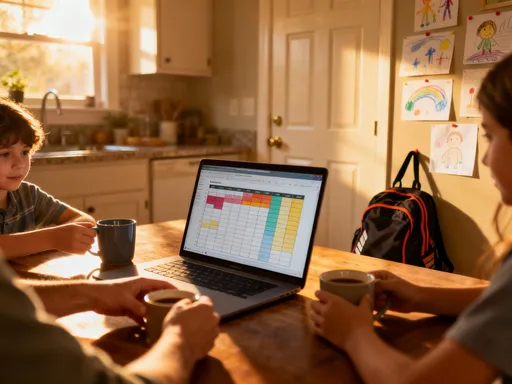
From Chaotic Schedules to Family Harmony: How a Simple Spreadsheet Transformed Our Home Life
Imagine trying to sync school drop-offs, gym sessions, dinner plans, and your partner’s late shifts—only to miss your kid’s soccer game. I’ve been there. It felt like everyone’s needs were important, but no system could hold them together. Then we tried something unexpectedly simple: a shared online spreadsheet. Not flashy, not automated—but alive with our routines, fitness goals, and family moments. This is how it quietly brought order, peace, and even more time for what truly matters.
The Breaking Point: When Family Life Felt Like a Juggling Act
It was a Tuesday morning, and I was already behind. My younger daughter couldn’t find her cleats, my oldest was crying because she’d forgotten her science project, and my partner had left for work without coffee—again. I looked at the kitchen calendar, scribbled over in three different colors, half the entries crossed out or rewritten. The gym bag sat in the corner, untouched for the third week in a row. I had big plans to get stronger, to feel better, to finally fit into those jeans—but life kept happening. And every time I tried to carve out time for myself, it felt like someone else was left holding the short end of the stick.
I wasn’t failing because I didn’t care. I was failing because I couldn’t see everything at once. The school pickup changed on Wednesdays. The grocery store was closed on Sundays. My yoga class was at 9, but only if the babysitter could come. It wasn’t one big disaster—it was a thousand tiny ones, piling up until I felt like I was running a marathon with no finish line. I’d lie in bed at night, mentally replaying the day: Did I remember to sign the field trip form? Did I text the teacher about the allergy? Did I even drink enough water?
And then there was the guilt. The quiet voice that said, You’re supposed to have it all together. You’re the mom. You’re the one who’s supposed to make it work. But no one ever told me how. We’d tried planners. We’d tried phone reminders. We even tried one of those fancy family organizer apps—complete with push notifications and chore charts. But within a week, it was abandoned. Too many steps. Too many passwords. Too much pressure to be perfect. I didn’t need another thing to manage. I needed something that could grow with us—something that wasn’t rigid, but real.
Discovering the Unlikely Hero: Why We Tried an Online Spreadsheet
The idea came from my cousin Sarah, over a blurry Zoom call one Sunday evening. She was holding a mug, her hair in a messy bun, and she said, “We just use a Google Sheet. Nothing fancy.” I almost laughed. A spreadsheet? That thing I associated with taxes and expense reports? That felt like something from my old office job, not my chaotic kitchen counter. But she showed me hers—color-coded blocks, simple labels, everyone’s name in a different font. “We all edit it,” she said. “The kids even add emojis when they finish homework.”
I was skeptical. But that night, after the kids were asleep, I opened a blank sheet. No templates. No tutorials. Just a grid. And slowly, I started typing. Monday. Tuesday. Drop-off times. My gym slot. Dinner plans. I added a row for my partner’s work schedule. Another for the kids’ after-school activities. I used soft pastel colors—blue for school, green for fitness, pink for family time. It wasn’t perfect. But it was there. Visible. Shareable. And most importantly—editable.
What surprised me was how fast it felt like ours. We didn’t need to download anything. No subscription fees. No confusing menus. Just a link we could all access from our phones, tablets, or the laptop on the kitchen table. I showed my partner the next morning, and instead of rolling his eyes, he said, “Wait—can I add my sleep tracker?” And just like that, it wasn’t just my system. It was ours. The beauty of it? It didn’t demand perfection. It didn’t judge. It just held space for our lives, exactly as they were—messy, changing, and full of love.
Building Our Family Dashboard: Fitness, Meals, and Shared Time
We didn’t turn it into a corporate project. We kept it simple. The first tab was our weekly schedule—time blocks for school, work, and activities. But then we added more. A second tab for meal planning. Every Sunday night, we’d sit together—sometimes with snacks, sometimes with the TV on low—and plan the week’s dinners. I’d type: “Mon: Baked chicken, rice, broccoli.” “Tues: Taco night (kids pick toppings).” And right there, a grocery list auto-populated from the meals we chose. No more 7 PM panic about “What’s for dinner?” No more driving back to the store for onions we forgot.
The third tab was for fitness. This was personal for me. I’d spent years feeling like self-care was a luxury I couldn’t afford. But now, I blocked time like it was a doctor’s appointment. “Wed 7:15 AM: 20-min strength video.” “Fri 6 PM: Walk with Maya.” I didn’t need to do an hour. I didn’t need fancy equipment. I just needed to see it. And when I did, I showed up. My partner added his sleep goals—“Target: 7 hours.” My daughter started tracking her daily steps with her school fitness tracker. We didn’t compete. We celebrated. A simple ✅ felt like a win.
And then came the fourth tab: Family Time. This one changed everything. Every Friday, the kids got to pick an activity—movie night, board games, bike ride, pancake breakfast. We’d write it in bold, add a little emoji (🍿 or 🚴), and suddenly, it wasn’t just another evening. It was something to look forward to. I noticed something subtle but powerful: when the kids saw their idea on the sheet, they felt heard. When my partner saw my workout blocked in, he stopped saying, “Can you make dinner?” during that time. The spreadsheet didn’t just organize our days—it gave everyone a voice.
Making Fitness Possible—Even on the Craziest Days
Let’s be honest—some days, the idea of working out feels impossible. The school calls. The dog needs the vet. The laundry overflows. But here’s what the spreadsheet taught me: fitness isn’t about perfect conditions. It’s about showing up, even in small ways. I started scheduling “micro-workouts”—10-minute yoga flows, 15-minute walks, even 5 minutes of stretching while dinner cooked. And because I wrote it in the sheet, it felt real. It wasn’t “I’ll try to move today.” It was “7:05 AM: 10-min stretch—done.”
One morning, my alarm went off at 6:50. I was exhausted. I wanted to roll over. But I looked at my phone and saw it—highlighted in green: “7:00 AM: Yoga.” I thought, Five minutes. Just five. I rolled out the mat, did three poses, and ended up doing the full session. Why? Because it was already on the calendar. Because it was visible. Because it was part of the plan. And that small win? It carried me through the day. I felt stronger. Calmer. More in control.
And it wasn’t just about me. My kids started noticing. “Mom, you did your yoga!” my youngest said one morning. “Can I do it with you?” We did a kid-friendly flow together. My partner started joining for weekend walks. We weren’t training for a marathon. We were building a habit—a culture of movement in our home. I realized that by taking care of myself, I wasn’t taking away from them. I was showing them how to care for themselves. That’s a lesson no app could teach.
How the Spreadsheet Became Our Family’s Quiet Communicator
Before the spreadsheet, our conversations were full of tension. “Did you pick up the dry cleaning?” “Why didn’t you tell me the meeting was moved?” “You always forget my soccer game!” It wasn’t that we didn’t care. It was that we were overwhelmed. We were carrying too much in our heads. The spreadsheet didn’t replace talking—but it changed how we talked. Now, instead of blame, we had clarity.
One afternoon, I saw that my partner had moved his workout from 6 PM to lunchtime. I sent a quick message: “Saw you squeezed in your run—great job!” He replied, “Thanks! Felt so good.” No reminder. No nagging. Just recognition. That small exchange shifted something. We weren’t policing each other. We were supporting each other. When the kids saw a ✅ next to their homework, they’d shout, “I’m on the board!” And when I missed a workout, no one said a word. But my daughter drew a little sun next to it and wrote, “Try tomorrow!”
The spreadsheet became a mirror of our efforts—a quiet way to say, “I see you. I appreciate you.” It reduced the mental load, yes, but it also deepened our connection. We weren’t just sharing a schedule. We were sharing a life. And in a world that often pulls families in different directions, that made all the difference.
Simple Tweaks That Kept It Alive (No Perfection Needed)
Here’s the truth: we didn’t stick to it perfectly. Some weeks, the meal plan was ignored. Some days, the fitness box stayed empty. And you know what? That’s okay. The power wasn’t in perfection—it was in consistency. We made it work by keeping it flexible. Every Sunday, we had a 10-minute “sync-up.” No pressure. Just a quick look at the week ahead. “Who needs rides?” “What’s for dinner Tuesday?” “Who wants to plan Friday fun?”
We used emojis to keep it light. A 💪 for a completed workout. A 🍝 for homemade pasta night. A 🌙 for “Mom needs quiet time.” The kids started adding doodles—a smiley face, a rainbow, a tiny dog. The sheet wasn’t pristine. It had coffee stains (real ones, from my morning mug). It had typos. It had last-minute changes scribbled in red. But it was alive. And because it didn’t demand perfection, we kept coming back to it.
We also made sure it was accessible. Everyone had the link saved on their phone. We used the Google Sheets app, so we could update it from the grocery store, the gym, or the school pickup line. No one had to be tech-savvy. No one had to learn a new system. It grew with us—adding a tab for vacation planning, another for birthday gifts. It wasn’t a rigid tool. It was a living document of our family’s rhythm.
More Than a Tool—How It Gave Us Back Time and Peace
Looking back, I realize the spreadsheet didn’t just organize our time. It gave us back our peace. The mental clutter faded. I wasn’t constantly asking, “What’s next?” or “Did I forget something?” I could breathe. I could be present. And that presence changed everything. I started noticing small things—the way my daughter laughs when she’s trying not to, the way my partner hums when he’s cooking, the quiet joy of a shared meal without phones on the table.
We still have busy days. We still have moments of chaos. But now, there’s a foundation. A system that holds the weight so we don’t have to. I feel more capable. More in control. Not because I’m doing more—but because I’m doing what matters. I’m showing up for my family, and for myself. The fitness routine? It’s not about the number on the scale. It’s about the energy I have to play tag in the backyard. The meal planning? It’s not about perfect nutrition. It’s about the conversations we have over spaghetti, the way we laugh about who used the last of the cheese.
And that moment I missed—the soccer game? We don’t miss those anymore. Not because we’re perfect, but because we’re aligned. The spreadsheet didn’t fix everything. But it created space—for connection, for growth, for joy. It reminded me that technology doesn’t have to be flashy to be powerful. Sometimes, the simplest tools—used with love and intention—can transform a home. And now, when I look at that shared sheet, I don’t see cells and colors. I see us. A family, not just surviving, but thriving—together.